
Vibration polishing is a decorative polishing technique that creates random polishing marks on metal surfaces. It is sometimes called random hairline or permanent hairline (PHL) and is used on stainless steel window frames, doors and windows, elevator components, and fixtures.
This article explains the differences between hairline finishes and mirror finishes, processing methods for stainless steel, aluminum, copper, and brass, how the finish affects the appearance, precautions against scratches and fingerprints, and how to choose the right finish for your application.
01What is vibration polishing?
Vibration polishing is a finishing technique that uses an eccentric rotating polishing head to create a non-directional, random polishing pattern on the surface. Because it creates a look that resembles irregularly overlapping straight hairlines, it is sometimes called random hairline or permanent hairline (PHL).
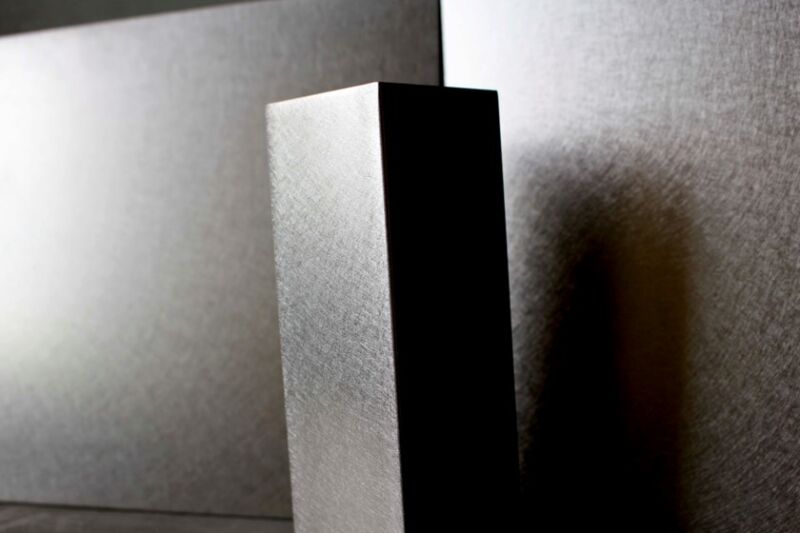
Typical product examples include Standard Vibration 18A , and for structural steel, there is Standard Vibration for square pipes and structural steel .

For a complete overview of stainless steel polishing methods , please see "What is stainless steel polishing?" . For a comparison of all surface finishes, please see " What is stainless steel surface finishing?" .
02Difference between hairline finish and mirror finish
| Finishing | Polished surface | Characteristics of how it looks |
|---|---|---|
| Hairline | A straight line in one direction | The direction is clear. Intersecting scratches are easily noticeable. |
| vibration | Non-directional/random | The appearance of reflections and scratches is adjusted based on the polishing surface conditions. |
| Mirror Surface | High-gloss surface with reduced polishing marks | The reflections are strong, making scratches and streaks easily visible. |
The detailed characteristics of hairline finishes are explained in " Hairline Polishing of Stainless Steel and Aluminum , " "What is Sheet Polishing?" (a method for adjusting the design of each individual piece) , and " What is Stainless Steel Mirror Polishing?" (for mirror finishes).
03Vibration polishing of stainless steel
With stainless steel, vibration finishing can be applied not only to sheet metal but also to square pipes, round pipes, angles, channels, and welded structures.

The final finish depends not only on the vibration polishing conditions but also on the surface condition of the base material, such as No. 2B, BA, #400, #700, and No. 8. For welded structures, selecting the base material with subsequent processes in mind is crucial to minimize color differences between the repaired welded area and the surrounding area.
The appearance of stainless steel vibration

The visibility of scratches and fingerprints varies depending on the depth and gloss of the polished surface. First, clarify the intended use and then determine the required polishing strength.
04Vibration processing of aluminum, copper, and brass
aluminum
For aluminum, vibrations should be considered for surface protection after finishing, such as anodizing, painting, or coating. Since the polishing marks and gloss will change depending on the treatment before anodizing, it is important to determine the polishing conditions with post-treatment in mind.
Copper and brass
While vibration can be applied to copper and brass, protective treatments such as clear coating should be considered to prevent discoloration and corrosion. Outdoors, the resulting aging process can also be used as a design element.

05Variations vary depending on the base material and polishing conditions.
Vibration polishing allows you to adjust the finish from fine to coarse by changing the eccentric rotation speed, the particle size and shape of the abrasive material, the feed conditions, and the base finish.
If fine grinding dust remains in the polished surface, it can mix with hand oils and appear as dirt. Post-finish cleaning is also a factor that affects the quality.
For designs that combine multiple polishing processes, please see our composite polishing technology , and for examples of combining mirror surfaces and 3D shapes, please see Mysterious Mirror® .
06Uses, selection, and precautions
Vibration polishing is used for building materials, elevators, fixtures, and equipment exteriors. Depending on the application, we check the depth of the polishing marks, gloss, visibility of scratches, fingerprints, and ease of post-processing and repair.
- If you want to make scratches less noticeable, check the depth and direction of the polishing marks.
- If welding is involved, choose a substrate that can accommodate future modifications.
- For aluminum, the post-treatment such as anodizing and painting is decided in advance.
- For applications where fingerprints are a concern, consider cleaning and coating options as well.
Examples of products designed with scratch resistance and ease of cleaning in mind include shines with waves® MD , and examples of handrails include stainless steel round pipes shines with waves .
Examples of tabletop finishes include converting a wooden tabletop to a stainless steel one, which can be a useful reference.

The BIM data mentioned in previous articles can be found on ARCH-LOG .

07FAQ
What is vibration polishing?
This is a decorative polishing technique that creates non-directional, random polishing marks on a metal surface, and is sometimes called random hairline or PHL.
What is the difference between this and a hairline?
Hairline finishes are characterized by straight, unidirectional polishing marks, while vibration finishes are characterized by random, overlapping polishing marks in no particular direction.
Does vibration polishing make scratches less noticeable?
The appearance of scratches varies depending on the polishing specifications. Since scratches may be more noticeable with shallower polishing, the specifications should be selected according to the intended use.
Can you process materials other than stainless steel?
Existing articles also cover processing of titanium, aluminum, copper, and brass. Post-processing and protection methods differ depending on the material.
Can you show me the actual polishing marks?
You can inquire about checking the product at our showroom/sample station .
08Summary
Vibration polishing is a design finish that utilizes non-directional polishing marks to adjust the appearance of gloss, reflection, and scratches.
Please select the polishing conditions according to the actual application, including the material, base coat, post-processing, and surface protection.
Please consult with us regarding the selection of materials, base coats, polishing finish, and post-treatment for vibration polishing.