
With decorative stainless steel panels, the impression they give to a space differs depending on whether they have a "homogeneous texture" with repeating patterns or a "non-uniform texture" where the polishing marks and reflections vary from panel to panel. Homogeneous expressions are suitable for spaces that emphasize regularity, while non-uniform expressions are suitable for designs that take advantage of the inherent luster, reflection, and depth of the metal.
01Examples of featured stainless steel decorative panels
Our decorative stainless steel panels, utilizing our composite polishing technology, were featured in the April 2019 issue of "Shinkenchiku" and the April 11, 2019 issue of "Nikkei Architecture."
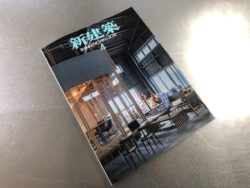
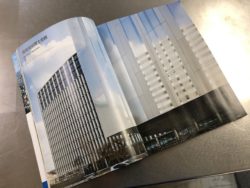

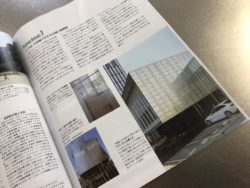
In the magazine, it is described as "the vertical stripes of the Hakata Kenjo pattern, formed by an uneven texture."
02Uneven texture expressing the Hakata Kenjo pattern


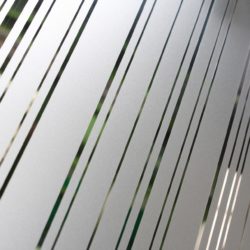
The design features vertical stripes across the entire wall surface, while up close, the fine patterns and variations in reflection created by polishing are visible.

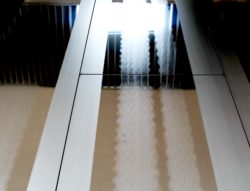
This design is composed of a combination of three types: a glossy buff finish, a wavy finish, and a String Curtain Cloud.
03Three types of polishing finishes
Glossy buff finish

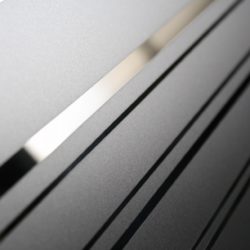
The parts that appear shiny like a mirror are the polished buffed finish. Compared to general buffs used in semiconductor manufacturing equipment and transportation equipment, it has better reflectivity and resolution, but unlike architectural mirror materials, vertical polishing lines appear.
In this case, it was chosen to match the concept of vertical stripes in the Hakata Kenjo pattern. Furthermore, to reduce reflection on the exterior wall, the reflection level was adjusted to approximately half that of typical architectural mirrored materials.
Wavy finish

The wave-like finish is an uneven finish that creates a sense of depth and three-dimensionality by overlapping shimmering patterns with different amplitudes. Using a dedicated design polishing machine, it creates a look where the reflections, shine, and polishing lines are not exactly the same, even though they follow similar trajectories.
For this exterior wall, we adjusted the amplitude, contrast, and perspective to create a texture that appears as vertical stripes from a distance and as diamonds from up close.
String Curtain Cloud

String Curtain is a polishing line inspired by a curtain of threads. At first glance, it looks like a hairline finish, but upon closer inspection, you can see that it forms a woven-like polishing pattern.
In this case, the contrast between the buffed and wavy areas was adjusted to create a highly visible line that is whiter and less reflective than the standard, in order to represent the white lines of the Hakata Kenjo pattern.
04Characteristics of a non-uniform texture
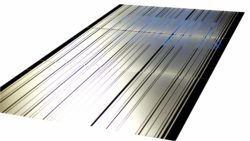
With an uneven texture, the trajectory of the polishing marks changes each time, so the same pattern is not repeated as in printing or transfer printing. It is possible to create lines that have an independent appearance while making use of the metal's natural luster and reflectivity.
On this exterior wall, a glossy buff with lines is used as the base, and two types of uneven polishing textures are combined to create a Hakata Kenjo pattern that changes appearance depending on the distance.
05Characteristics of a homogeneous texture
For uniform and consistent expression, methods such as masking and stenciling can be used. These methods are suitable for creating a unified space using metallic sheen, and are often used in public facilities.
06How to choose between homogeneous and heterogeneous textures
When emphasizing regularity and unity, a homogeneous representation is the appropriate choice. When emphasizing the reflection of metal, the variations in each individual piece, and depth, a heterogeneous representation is the better option. It is crucial for architects and designers to choose a method of expression that matches the space they intend to create.
The basic principles to consider when choosing exterior wall materials are also explained in our guide on selecting stainless steel exterior walls .
07FAQ
What is a homogeneous texture?
This texture is created by repeatedly forming the same pattern or expression using masking or stencils.
What is a heterogeneous texture?
Each piece has a unique texture, with no two pieces having the exact same polishing marks, reflections, or shine.
What kind of finish is used for this exterior wall?
It combines three types of finishes: glossy buff finish, wavy finish, and String Curtain Cloud.
08Summary
Homogeneous textures are suitable for expressions with regularity, while heterogeneous textures are suitable for expressions that utilize the inherent luster and reflective properties of metal. It is important to choose based on the concept of the space and the difference in impression depending on the viewing distance.
