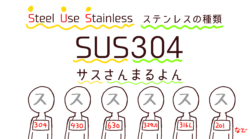
[First of all, this is the second installment of the series!]
What exactly is "stainless steel"?
Stainless steel is called Stainless Steel in English, which literally translates to stainless steel.
Stainless steel means "rust-free." (Strictly speaking, it means rust-resistant.)
It is an environmentally friendly metal as it is 100% recyclable.
Characteristics of Stainless Steel
Stainless steel is made up of iron as its main component (over 50%), with chromium added at over 10.5%.
It is an alloy that is extremely rust-resistant.
(★As chromium is added to iron, it becomes less susceptible to rust.)
In addition to corrosion resistance, it also has excellent properties such as heat resistance, workability, and strength.
Another major feature is its excellent design and ease of maintenance.
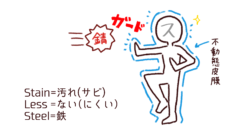
Why is it so resistant to rust?
A very thin film called a passive film (*) forms on the surface of stainless steel, preventing the progression of rust.
(*The passive film is formed when chromium and oxygen combine.)
Furthermore, this passive film is extremely thin, about 3 nanometers (100 millionths of a millimeter!),
It is extremely strong, and even if it is scratched and the film is broken, it has the ability to regenerate automatically if there is oxygen around it.
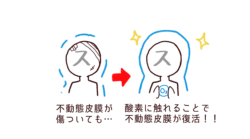
What do SUS304 and SUS430, which you often see, mean?
There are over 100 types of stainless steel.
SUS304 and SUS430 are just some of the many types of stainless steel available.
SUS is an acronym for "Steel Use Stainless" when written in English.
It is pronounced "Sasu sanmaru yon" or "Sasu yon sanmaru."
The number at the end indicates the type of stainless steel.
Depending on the type, they are classified as 200 series, 300 series, 400 series, 600 series, etc.
SUS304 is used all over the world and is the representative of the 300 series, as well as the representative of all types of stainless steel.