
Even with the same hairline finish, the appearance can vary greatly depending on the base material, plate thickness, gloss before polishing, grain direction, and surface treatment. In this article, we will use general-purpose hairline finishes as a baseline and compare examples from the original article, including No.2B and No.1 base materials, bright finishes, combinations of partial grain directions, and even aluminum hairline finishes.
01What makes the appearance of a hairline change?
Hairline polishing is one of the most common decorative finishes for stainless steel. It is used in a wide range of applications, including escalators, shops, and kitchens.
On the other hand, hairline finishes do not have a single, fixed appearance. The strength of the lines, the way they reflect light, and the color of the material all change depending on the base material, the thickness of the sheet metal, the gloss of the previous process, the direction of the polishing marks, and the surface treatment.
The definition, grit, and applications of hairline finishes are explained in detail in the basics section of the hairline finish guide , and the differences between stainless steel and aluminum are explained in the comparison of stainless steel and aluminum hairline finishes . This article will focus on the next step: "how to adjust the impression by slightly changing the conditions."
02Let's consider a general-purpose hairline finish as the standard.
First, the benchmark is a general-purpose hairline finish that is commonly available. The original article refers to our product name as mako-HL12N.
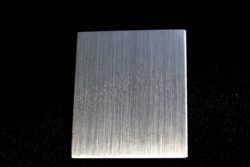
While general-purpose hairline finishes are easy to adopt, the original article points out that care must be taken to prevent scratches and stains, and that from a distance the lines may be difficult to see, making it appear as a silvery metal finish.
If you feel that a standard hairline finish lacks visual appeal, it's helpful to first consider which of the following elements you want to change: "base material/thickness," "undercoat gloss," "grain direction," or "additional surface treatment."
03The strength of the wire is varied depending on the base material and plate thickness.
The original article suggests a general-purpose hairline finish with a sheet thickness of approximately 0.3 to 3.0 mm. It also shows examples where the appearance of the hairline finish differs between No. 2B (cold-rolled base material) with a thickness of 3.0 to 6.0 mm and No. 1 (hot-rolled base material) with a thickness of 3.0 mm or more.
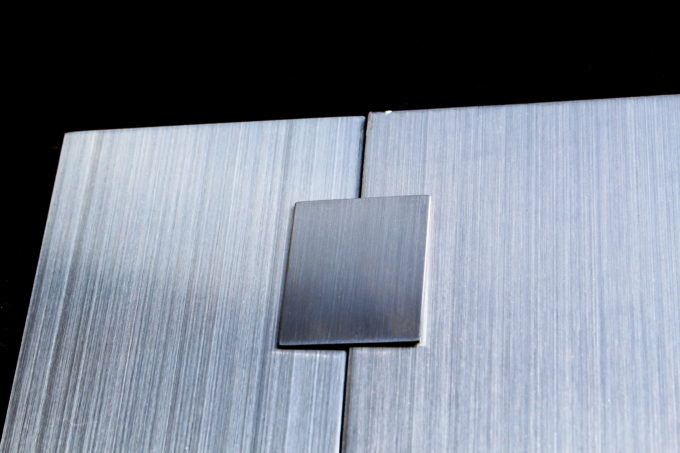
| Classification | Guideline for the original article | Product names in the article | Characteristics of how it looks |
|---|---|---|---|
| General-purpose hairline finish | Approximately 0.3 to 3.0 mm | mako-HL12N | A general standard facial expression |
| No.1 base material | 3.0mm or more | mako-HL4 | In the comparative example, the line is clearly visible. |
| Medium thickness No.2B base material | 3.0~6.0mm | mako-HL8 | A different look from generic products. |
The original article explains that the distinct hairline pattern of the No. 1 series can also be seen in flat bars, angles, channels, etc. For differences in the base materials between No. 1 and No. 2B, please refer to the comparison article of stainless steel base materials No. 2B and No. 1 .
Furthermore, the original article states that our equipment can handle polishing up to 6,000mm of standard-length material. In actual projects, it is important to confirm whether processing is possible, taking into account the material, plate thickness, and shape.
04Add gloss with a buffing base.
If you buff the surface to increase its gloss before applying the hairline finish, it will result in a different effect from a normal hairline finish, one that includes reflections.
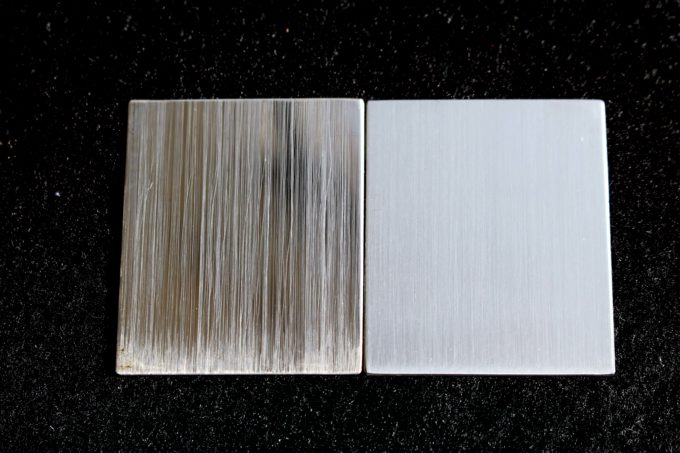
The original article introduces the finish on the left as an example, also known as bright hairline, and refers to the product name as mako-Squall . This is an option if you want to add a mirrored element.
For information on the role and equipment of buffing, please refer to the explanation of buffing in stainless steel polishing , and for the differences in gloss, including mirror finish and matte finish, please refer to the comparison of stainless steel surface finishes .
05Combining surface treatment and material color
The original article describes an example of combining surface hardening as a measure to address hairline scratches.
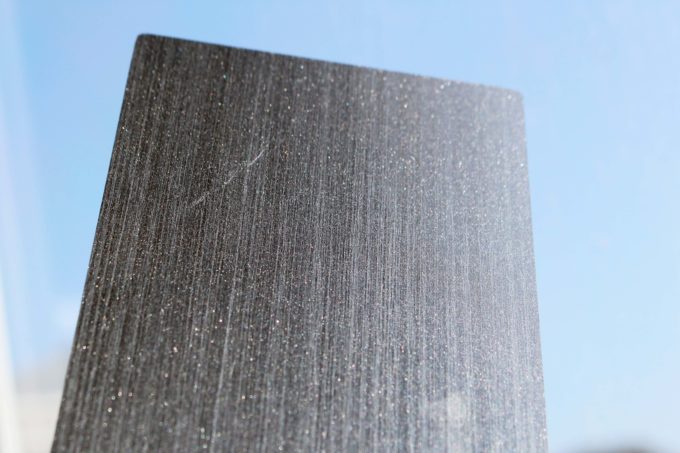
Furthermore, as an option to change the color of the material itself, the original article introduces "White Stainless NSSC FW2," a stainless steel for interior use. Information on FW2 is provided by Nippon Steel Stainless , and links to related design materials such as Yuragi and Steering Curtain are included.
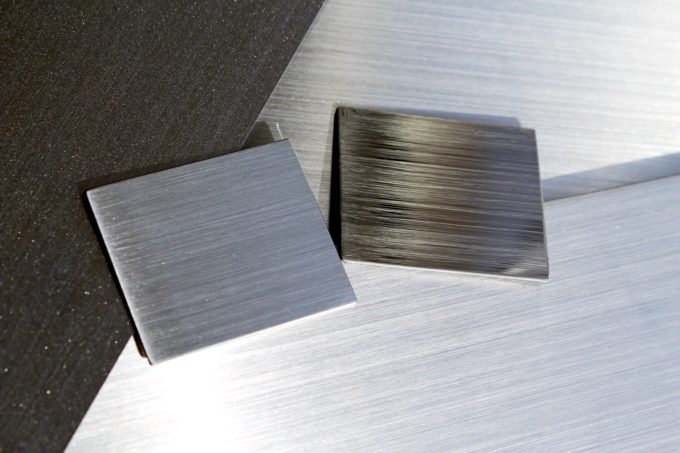
The characteristics of white stainless steel, its differences from SUS304, and its applications are all explained in the section on white stainless steel .
06Creating a three-dimensional effect by combining different eye directions.
Hairline finishes not only align the entire surface in the same direction, but also create a three-dimensional effect through differences in reflection by varying the direction of the grain vertically, horizontally, and diagonally in different sections.
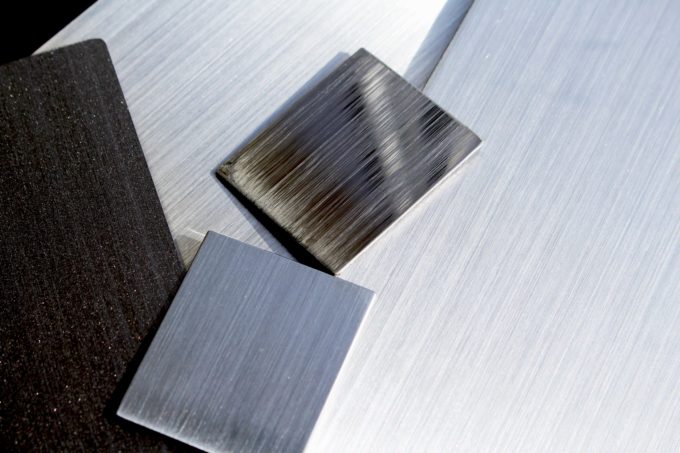
This method involves creating variations in the appearance of a single surface by changing the direction of the polishing marks, without adding any other materials. The idea of combining multiple polishing techniques is also applicable to 2D design combinations .
07Aluminum hairline
Hairline finishes exhibit a different texture not only in stainless steel but also in aluminum. The original article describes it as having a snow-like appearance, which is unique to aluminum.
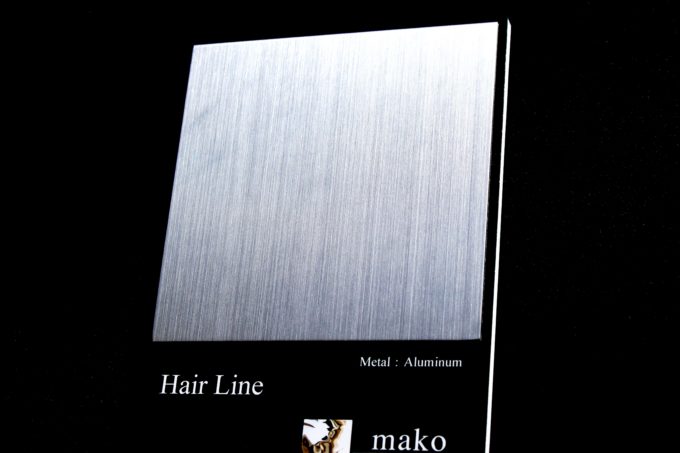
The original article suggests protecting the surface with protective tape immediately after polishing, and recommends MaCoat GC® as an example of a coating to consider when attaching the product to stores, fixtures, or equipment .
If you want to compare the differences between brushed stainless steel and aluminum, please see our comparison of brushed stainless steel and aluminum finishes .
08FAQ/Summary
What should I change to alter my look from a normal hairline?
In the original article's examples, the impression is altered by the combination of base material, plate thickness, gloss from buffing, surface treatment, and grain direction. The key is to choose the conditions based on the desired reflection and line strength.
Do the hairline lines look the same in No. 1 and No. 2B?
They are not the same. In the comparison example in the original article, you can see differences in how the lines appear when comparing the No. 1 base material, general-purpose material, and medium-thickness No. 2B material.
Is it possible to change the direction of the hairline?
This article introduces a method for creating a sense of depth by partially combining vertical, horizontal, and diagonal lines, and utilizing differences in reflection.
Summary
When changing the impression of a hairline finish, it's important to design not only the finish name, but also the base material, plate thickness, base gloss, surface treatment, and grain direction. By changing each condition one by one, starting with a general-purpose hairline finish, you can more easily get closer to the desired spatial image.